Home


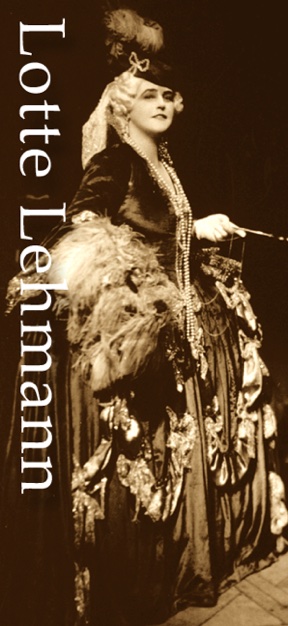
Lehmann as Tosca in 1936

Welcome to the site that focuses on two subjects: the German soprano, Lotte Lehmann (1888 – 1976) and art song. If you’ve arrived here for the first time, you’ll want to hear Lehmann sing! Dich, teure Halle. (Text & translation below). Or listen to her sing in English? Or sing lighter songs and operetta?  And what about who she was and wasn’t?! A bio or two would be good. You’ll enjoy some photos and a chronology (she sang a lot). Her colleagues and students have recorded tributes that you can sample. You can learn about Lehmann’s roles and repertoire, the books she wrote, books about her and her discography. Check out the page of Lehmann reading poetry. New pages: (as of March 2012) Lehmann Firsts; (as of April 2012) Famous Conductors for Whom Lehmann Sang.

For students of opera and song, you’ll enjoy hearing Lehmann’s masterclasses. You can read about her work with the leading conductors and pianists of her time, including Bruno Walter, Arturo Toscanini, Paul Ulanowsky, Ernö Balogh, Gwendolyn Koldofsky, etc. Here also, is a page about Lehmann’s companion Frances Holden.

And how does Lehmann compare to other singers? You can enjoy singers of her time and our time in the same aria or song. Here’s a little game for you vocal experts: I’ve conflated four versions of Schubert’s Gretchen am Spinnrade, can you tell me who is singing each verse? (I’ll put the answer at the bottom of the page with the text & translation.)

Winterreise was Lehmann’s favorite work; she was the first woman to record the cycle; she painted watercolors to go with each song and recorded the poetry, and you can sample all of this.

Lehmann taught and coached many singers, I’m trying to list as many as I can. Please send me names of those I’ve missed.

We’ll also try to keep you informed about news related to Lehmann, such as an  obituary of one of her assistants and biographers, Beaumont Glass and “Waltraud Meier Receives the Lotte Lehmann Memorial Ring.” Now you can hear a slightly cleaned up version of the acoustically horrible (but exciting) short-wave broadcast of Toscanini conducting Lehmann in the Abscheulicher and Komm’ Hoffnung of 16 August 1936.  Also, the latest internet searches to find unusual Lehmann performances. At Amazon you can search through hundreds of available Lehmann recordings sampling or buying. YouTube has posted a really well-filtered version of one of Lehmann’s most popular recordings, the 1924 acoustic of Korngold’s famous duet from Die tode Stadt with Richard Tauber.

What about art song? First a quick definition: poetry set to music for classical voice and piano. Yes, there are art songs with orchestra etc., but that will do for a beginning. You already know at least one art song, Brahms’ Lullaby. (You can find the text & translation below.) And go to the sample page where you can hear many other songs that you know, but may not have known as art songs. There’s many songs in many languages to hear in the art song world. You can hear lots of them on the art song page. For those of you who like the visual aspect I put together a movie called Three American Art Songs. Each of the songs is in its own scenario. Enjoy!

Hawaii Public Radio has re-instigated its Art Song Contest and it’s worldwide, free, with no age restrictions. Do consider entering and tell your friends about it.

You can see and hear French mélodie, German Lieder, Spanish cancion classica, and American art song, just by going to LyricLanguages. I offer the original poem, an English translation and beautiful images to accompany the song. On the art song page I provide samples of many great singers, past and present, some unusual examples and even some spoofs.

Finally, you may read about me, Gary Hickling, and my connection to Lehmann and art song. I founded the Lotte Lehmann Foundation in 1997, serving as its president for six years and stepping down completely in 2005. But I find myself still obsessed with Mme. Lehmann, her wonderful voice and fascinating personality. So now I’m having fun allowing her to live again with this website in a personal rather than an institutional way.

When I was preparing one of my radio programs for WBAI in New York City, I approached one of the most art song-knowledgeable I could find, Philip Miller. The program was to be the “top 40″ Schubert Lieder by 40 different singers. He helped tremendously. Finally, I asked him to recommend one of the many songs of Schubert recorded by Lehmann. He said, without hesitation, that though Lehmann was 60 years old when she recorded it for RCA, there wasn’t a more beautiful version to be found of An den Mond. (There’s text & translation below.) This is not the Schubert Lied to Goethe poetry, but rather to that of Hölty.

Singers in Gretchen am Spinnrade quiz above: Jeannine Altmeyer (Lehmann’s last student); Lehmann herself; Gundula Janowitz; Elisabeth Schumann.

Translations for this page:

Gretchen am Spinnrade (Gretchen at the Spinning Wheel) is one of the most famous songs that Schubert wrote and he accomplished this feat at the tender age of 17! Listen to the spinning in the piano part and when she sings of his kiss, the movement stops and little by little starts up again, as a spinning wheel would. Goethe, the poet of these words, never heard this song, but I’m quite sure he would have liked it, despite his dictum that the mind’s ear shouldn’t be distracted from the words.
Meine Ruh’ ist hin,
Mein Herz ist schwer,
Ich finde sie nimmer
Und nimmermehr. 

Wo ich ihn nicht hab
Ist mir das Grab,
Die ganze Welt
Ist mir vergällt.

Mein armer Kopf
Ist mir verrückt,
Mein armer Sinn
Ist mir zerstückt.

Nach ihm nur schau ich
Zum Fenster hinaus,
Nach ihm nur geh ich
Aus dem Haus.

Sein hoher Gang,
Sein’ edle Gestalt,
Seine Mundes Lächeln,
Seiner Augen Gewalt,

Und seiner Rede
Zauberfluß,
Sein Händedruck,
Und ach, sein Kuß!

Mein Busen drängt sich
Nach ihm hin.
Ach dürft ich fassen
Und halten ihn,

Und küssen ihn,
So wie ich wollt,
An seinen Küssen
Vergehen sollt!

My peace is gone,
My heart is heavy,
I will find it never
and never more. 

Where I do not have him,
It is like the grave to me.
The whole world
Is bitter to me.

My poor head
is deranged.
My poor mind
distracted.

For him only, I look
Out the window
Only for him do I go
Out of the house.

His tall bearing
His noble form,
The smile of his lips,
His eyes’ power,

And his talk’s
Magic flow,
The clasp of his hands,
and ah! his kiss!

My heart yearns
for him.
Ah, might I grasp
And hold him!

And kiss him,
To my heart’s content,
Under his kisses
to swoon!

Dich, teure Halle; Elisabeth’s aria from the opera Tannhäuser. Text and words by Richard Wagner.
In the singer’s hall of the Wartburg, Elizabeth joyously greets the place of Tannhäuser’s former triumphs. She is confident that Tannhäuser will win the impending contest for which her hand in marriage is the prize.
Dich, teure Halle, grüss ich wieder,
froh grüss ich dich, geliebter Raum!
In dir erwachen seine Lieder und wecken mich aus düstrem Traum.
Da er aus dir geschieden,
wie öd’ erschienst du mir!
Aus mir entfloh der Frieden,
die Freude zog aus dir.
Wie jetzt mein Busen hoch sich hebet,
so scheinst du jetzt mir stolz und
hehr.
Der mich und dich so neu belebet,
nicht weilt er ferne mehr,
Du teure Halle, sei mir gegrüßt!
Dear hall, I greet you once again,
joyfully I greet you, beloved place!
In you his songs awake
and waken me from gloomy dreams.
When he departed from you,
how desolate you appeared to me!
Peace forsook me,
joy took leave of you.
How strongly now my heart is leaping;
to me now you appear exalted and sublime.
He who thus revives both me and you,
tarries afar no more.
You dear hall, I greet thee!

An den Mond (To the Moon) contains a target subject favored by many poets and composers. In this case the poet was Hölty and the composer Schubert.

Geuß, lieber Mond, geuß deine Silberflimmer
Durch dieses Buchengrün,
Wo Phantasien und Traumgestalten immer
Vor mir vorüberfliehn! 

Enthülle dich, daß ich die
Stätte finde,
Wo oft mein Mädchen saß,
Und oft, im Wehn des Buchbaums und der Linde,
Der goldnen Stadt vergaß!

Enthülle dich, daß ich des Strauchs mich freue,
Der Kühlung ihr gerauscht,
Und einen Kranz auf jeden Anger streue,
Wo sie den Bach belauscht!

Dann, lieber Mond, dann nimm den Schleier wieder,
Und traur’ um deinen Freund,
Und weine durch den Wolkenflor hernieder,
Wie ein Verlaßner weint!

Pour, dear moon, pour your silver shimmer
through the beechtree green,
Where phantasms and dream-shapes always
Float before me! 

Reveal yourself, that I may find the place
Where my darling often sat,
And often, in the wind of beech and linden trees,
Forgot the golden city!

Reveal yourself, that I may enjoy the bushes
Which swept coolness to her,
And that I may scatter a wreath upon that green,
Where she listened to the brook.

Then, dear moon, then take up your veil again,
And mourn your friend,
And weep through the clouds
below,
As one forsaken weeps!


Johannes Brahms’ Wiegenlied: Guten Abend, gute Nacht (“Good evening, good night”), Op. 49, No. 4 (published in 1868). The first verse is taken from a collection of German folk poems called Des Knaben Wunderhorn; the second stanza was written by Georg Scherer (1824–1909) in 1849.
Guten Abend, gut Nacht,
Mit Rosen bedacht,
Mit Näglein besteckt,
Schlupf unter die Deck’:
Morgen früh, wenn Gott will,
Wirst du wieder geweckt. 

Guten Abend, gute Nacht,
Von Englein bewacht,
Die zeigen im Traum
Dir Christkindleins Baum.
Schlaf nun selig und süß,
Schau im Traums Paradies

Good evening, good night,
With roses adorned,
With carnations covered,
Slip under the covers.
Tomorrow morning, if God wants it,
You will wake again. 

Good evening, good night.
By angels watched,
Who show you in your dream
The Christ-child’s tree.
Sleep now peacefully and sweetly,
Look in dream’s paradise.

Comments are closed.